
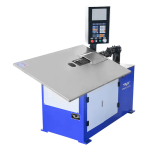


The increasing complexity of wire products has encouraged manufacturers to adopt advanced forming equipment. Among these technologies, the Camless Wire Bending Machine has gained attention for its ability to create various wire shapes while supporting flexible production requirements. Through servo-driven control systems, this equipment provides a practical approach to wire processing across multiple industries.
Wire components can be found in many products used every day. Automotive assemblies include wire clips, brackets, springs, retainers, and fastening elements. Furniture manufacturers use formed wire parts in seating systems, storage products, and structural supports. Household appliances often contain wire frames and internal support structures. A Camless Wire Bending Machine helps produce these components with controlled accuracy and repeatability.
One reason manufacturers choose this equipment is its ability to accommodate changing product specifications. Traditional bending systems may require mechanical modifications when switching between different designs. In contrast, a Camless Wire Bending Machine allows operators to adjust parameters through software. This reduces setup time and simplifies transitions between production jobs.
The production cycle begins with wire feeding from a coil. Servo-controlled rollers guide the material into the machine. Specialized tooling then performs bending operations according to the programmed sequence. Depending on the application, the machine may create multiple bends, loops, hooks, or custom geometric forms during a single cycle.
Another benefit involves material utilization. Accurate feeding and positioning help reduce unnecessary waste. By controlling wire movement with programmed instructions, manufacturers can achieve more consistent results while managing raw material consumption.
The machine is also suitable for both large and small production runs. For companies handling customized projects, the ability to quickly switch programs provides operational flexibility. For larger production volumes, automated processing can support stable output and efficient workflow management.
Operator interaction is typically simplified through digital interfaces. Production data, bending angles, and wire lengths can be entered and adjusted directly on the control panel. Some systems may also support data storage for frequently manufactured parts, making repeat production more convenient.
Maintenance remains an important aspect of machine performance. Regular inspection of tooling, feeding mechanisms, servo drives, and wire guides helps maintain reliable operation. Proper maintenance scheduling can contribute to stable production and longer equipment service life.
As industries continue to seek adaptable manufacturing solutions, the Camless Wire Bending Machine plays an important role in wire component production. Its programmable nature, flexible operation, and ability to handle diverse wire designs support modern manufacturing objectives across numerous sectors.
https://www.spring-machine.net/product/wire-bending-machines/