
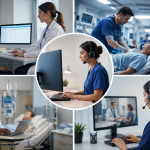


Healthcare providers today face growing documentation demands. Electronic health records (EHRs), compliance requirements, coding accuracy, and patient care documentation all compete for physicians’ time. As administrative workloads increase, many healthcare organizations are turning to medical scribes to improve efficiency and reduce physician burnout.
Medical scribes assist providers by documenting patient encounters, updating medical records, and supporting clinical workflows. However, not all scribes work in the same environment. Different healthcare settings require different types of scribe support. Understanding these options can help practices choose the right solution for their needs.
What Is a Medical Scribe?
A medical scribe is a trained documentation professional who records patient visits and clinical information on behalf of healthcare providers. Scribes work alongside physicians, nurse practitioners, and other clinicians to ensure medical records remain accurate, complete, and compliant.
By handling documentation tasks, scribes allow providers to spend more time focusing on patient care rather than data entry.
Outpatient Scribes
Outpatient scribes support physicians working in clinics, specialty practices, and ambulatory care settings. These scribes document routine office visits, follow-up appointments, preventive care visits, and specialty consultations.
Outpatient practices often see a high volume of patients each day. Providers may have only a few minutes between appointments to complete documentation, review charts, and prepare for the next patient. An outpatient scribe helps manage this workload by documenting encounters in real time.
Common responsibilities of outpatient scribes include:
- Recording patient histories and chief complaints
- Documenting physical examination findings
- Updating medication and allergy lists
- Entering treatment plans and follow-up instructions
- Assisting with chart completion
Outpatient scribes are commonly found in family medicine, cardiology, dermatology, orthopedics, gastroenterology, neurology, ophthalmology, and many other specialties.
Emergency Department Scribes
Emergency department (ED) scribes work in one of the most demanding healthcare environments. Emergency physicians must evaluate patients quickly while managing unpredictable patient volumes and complex cases.
Accurate documentation is critical in the emergency department because medical decisions often need to be made rapidly. At the same time, providers must maintain detailed records for legal, billing, and quality assurance purposes.
Emergency scribes help by documenting:
- Patient arrival information
- History of present illness
- Physician assessments
- Diagnostic test results
- Procedures performed
- Discharge instructions and follow-up plans
Because emergency departments operate around the clock, ED scribes may work day, evening, overnight, or weekend shifts. Their support helps physicians maintain complete records while staying focused on urgent patient care needs.
Virtual Medical Scribes
Virtual medical scribes provide documentation support remotely through secure audio and video technology. Instead of being physically present in the exam room, virtual scribes listen to patient encounters and complete documentation from a remote location.
Virtual scribing has become increasingly popular because it offers flexibility and scalability for healthcare organizations.
Benefits of virtual scribes include:
- Reduced staffing and space requirements
- Access to trained documentation specialists
- Coverage across multiple locations
- Flexible scheduling options
- Lower operational costs in many cases
Virtual scribes can support both outpatient clinics and hospital-based providers. Many healthcare organizations choose virtual scribing because it provides the benefits of traditional scribe services without requiring an on-site presence.
In-Person Medical Scribes
In-person scribes work directly alongside physicians within the clinical setting. They may accompany providers from room to room, observe patient interactions, and document encounters in real time.
This model allows immediate communication between the provider and scribe, making it easier to clarify details and ensure documentation accuracy.
In-person scribes are commonly used in hospitals, specialty clinics, emergency departments, and high-volume outpatient practices.
Hospital Scribes
Hospital scribes support physicians and specialists working in inpatient settings. Their responsibilities often include documenting admissions, progress notes, consultations, discharge summaries, and care coordination activities.
Hospital documentation can be particularly complex because patients often receive care from multiple providers across several departments. Scribes help ensure medical records remain complete and organized throughout the patient's stay.
Hospital scribes are especially valuable during overnight shifts and periods of high patient volume when documentation demands can become overwhelming.
Choosing the Right Type of Medical Scribe
The ideal scribe model depends on a practice’s specialty, patient volume, staffing structure, and documentation requirements.
Practices that manage large numbers of office visits may benefit most from outpatient scribes. Emergency departments often require specialized ED scribes who understand fast-paced workflows. Organizations seeking flexibility and scalability may find virtual scribes to be the most cost-effective solution.
Evaluating workflow challenges, provider preferences, and long-term operational goals can help determine the best fit.
Conclusion
Medical scribes play a vital role in helping healthcare organizations manage growing documentation demands. Whether supporting outpatient clinics, emergency departments, hospitals, or remote care environments, scribes help providers maintain accurate records while focusing more attention on patient care.
As healthcare continues to evolve, understanding the different types of medical scribes can help practices select the right documentation support model, improve efficiency, and create a better experience for both providers and patients.