
In modern manufacturing, welding operations generate intense heat, flying sparks, and molten slag every day. While welding curtains are often viewed as simple safety accessories, their performance has a direct impact on worker protection, equipment reliability, and workplace air quality.
Unfortunately, not all welding curtains are designed for continuous exposure to extreme temperatures. In high-amperage welding environments, conventional protective fabrics may soften, deform, or even release harmful smoke, creating new safety risks instead of preventing them.
This article examines why traditional welding curtains often fail in demanding industrial applications and how Zhuowei's vermiculite-coated fiberglass fabric provides a more durable, high-temperature solution.
The Challenge: When Heat Exceeds the Limits of Conventional Welding Curtains
A precision manufacturing facility in California experienced recurring problems in its welding area, where multiple high-current welding stations operated continuously throughout the day.
The original protective curtains performed adequately during light-duty operations, but under prolonged exposure to radiant heat and molten metal spatter, several issues became increasingly apparent:
- The curtain material gradually softened and lost its original shape.
- Continuous exposure to heat caused noticeable stretching and deformation.
- The surface began producing unpleasant smoke and odor during operation.
- Local ventilation systems had to work harder to remove airborne contaminants.
- Workplace air quality became a growing concern during environmental inspections.
The facility needed a replacement material capable of maintaining structural stability while eliminating smoke generation under continuous high-temperature conditions.
Why Traditional Welding Curtains Break Down
Many commercially available welding curtains are manufactured using fiberglass combined with polymer coatings or synthetic materials to improve flexibility.
Although these materials perform well under moderate temperatures, they often reach their performance limits in heavy industrial welding applications.
1. Thermal Decomposition of Organic Coatings
Many conventional curtains contain organic coatings that begin to degrade when exposed to prolonged radiant heat.
As temperatures continue to rise, these materials may:
- Release visible smoke
- Produce unpleasant odors
- Generate volatile compounds
- Reduce workplace air quality
Besides affecting operator comfort, this additional smoke also increases the burden on factory ventilation systems.
2. Loss of Mechanical Strength
Another common problem is structural degradation.
Standard fiberglass fabrics may gradually lose mechanical strength after long-term exposure to elevated temperatures.
Typical symptoms include:
- Surface softening
- Permanent deformation
- Sagging
- Reduced tensile strength
- Increased vulnerability to molten metal impact
Once damaged, the curtain can no longer provide reliable separation between welding areas.
A Different Approach: Vermiculite-Coated Fiberglass
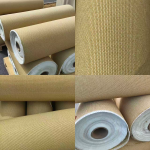
To solve these issues, Zhuowei developed a high-temperature protective fabric using premium fiberglass combined with an inorganic vermiculite coating.
Unlike traditional organic coatings, vermiculite is a naturally occurring mineral with excellent thermal stability.
When exposed to extreme temperatures, the coating forms a highly stable ceramic-like protective layer that helps shield the fiberglass beneath from excessive heat.
This material offers several important advantages:
- Excellent high-temperature resistance
- Non-combustible performance
- No polymer decomposition
- Reduced smoke generation
- Improved thermal insulation
Because the coating contains no organic polymer matrix, it remains stable even during prolonged exposure to temperatures above 700°C.
Improved Protection Against Molten Sparks
Heat resistance alone is not sufficient in heavy welding environments.
Protective fabrics must also withstand repeated impacts from molten metal droplets and welding slag.
To improve durability, Zhuowei optimized the structural design of the fiberglass fabric by increasing weave density and enhancing yarn construction.
The denser fabric structure provides several benefits:
- Greater resistance to molten spatter
- Improved mechanical strength
- Better puncture resistance
- Longer service life
- Reduced fabric deformation
Instead of allowing molten particles to penetrate the material, the dense surface helps cool and deflect hot sparks before they can damage the curtain.
Smoke-Free Operation Helps Improve Workplace Safety
For industrial facilities, indoor air quality is becoming increasingly important.
Reducing airborne contaminants benefits both employees and production equipment.
Because Zhuowei's vermiculite-coated fabric contains an inorganic coating rather than heat-sensitive polymers, it produces virtually no smoke during normal high-temperature operation.
This helps facilities:
- Improve visibility around welding stations
- Reduce ventilation system workload
- Support healthier working environments
- Lower maintenance requirements for air handling equipment
For companies focused on Environmental, Health, and Safety (EHS) management, smoke-free operation can be a significant advantage.
Independently Tested Performance
Industrial buyers increasingly expect objective verification rather than marketing claims alone.
To ensure product reliability, Zhuowei's vermiculite-coated fiberglass fabric undergoes comprehensive third-party testing in accordance with internationally recognized standards.
Testing evaluates important performance characteristics including:
- Flame resistance
- Mechanical strength
- High-temperature performance
- Smoke generation
- Material durability
Independent testing provides greater confidence when selecting protective materials for demanding industrial environments.
Real Benefits Observed in Industrial Applications
After replacing its aging welding curtains with Zhuowei's upgraded solution, the California manufacturer experienced several measurable improvements.
Improved Air Quality
The previous smoke generated by heat-degraded curtains was eliminated, helping create a cleaner working environment.
Better Thermal Protection
The new curtains maintained their shape even during continuous welding operations without noticeable softening or sagging.
Greater Durability
High-density fiberglass construction significantly improved resistance to molten slag and mechanical wear, extending service life.
Long-Term Cost Savings
Because the curtains required less frequent replacement and reduced maintenance demands, the facility lowered its overall operating costs while improving production stability.
Encouraged by these results, the manufacturer expanded its cooperation with Zhuowei to include additional thermal protection products for automated robotic welding systems and other high-temperature production equipment.
Typical Applications
Vermiculite-coated fiberglass fabrics are suitable for a wide range of industrial heat protection applications, including:
- Welding curtains
- Welding blankets
- Robotic welding enclosures
- Heat shields
- Furnace protection
- High-temperature partitions
- Equipment insulation barriers
- Industrial fire-resistant covers
Their combination of thermal resistance and mechanical durability makes them suitable for industries such as automotive manufacturing, heavy equipment production, shipbuilding, metal fabrication, and energy facilities.
Why More Manufacturers Are Choosing Advanced Thermal Protection
As industrial production becomes increasingly automated and safety standards continue to evolve, manufacturers are placing greater emphasis on long-lasting protective materials.
Compared with conventional welding curtains, advanced vermiculite-coated fiberglass offers several important advantages:
- Higher continuous temperature resistance
- Reduced smoke generation
- Improved workplace safety
- Better resistance to molten metal
- Longer operational lifespan
- Lower maintenance costs
- Greater overall reliability
These benefits help facilities improve both operational efficiency and long-term return on investment.
Final Thoughts
Choosing the right welding curtain involves much more than meeting basic fire protection requirements.
In demanding industrial environments, protective barriers must withstand continuous heat, resist molten metal impact, maintain structural integrity, and support a cleaner working environment.
With its premium fiberglass construction, inorganic vermiculite coating, high-density weave, and independently verified performance, Zhuowei's vermiculite-coated fiberglass fabric provides a reliable solution for manufacturers seeking safer, more durable, and more energy-efficient thermal protection.
For facilities looking to upgrade welding safety while reducing maintenance and improving production reliability, investing in advanced high-temperature protective fabrics is a practical and cost-effective decision.
https://www.sqzwxc.com/solving-the-problem-of-welding-curtain-fumes-and-heat.html