
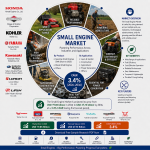

The global Small Engine Market is estimated to reach USD 19.85 billion in 2026 and is projected to attain USD 27.73 billion by 2036, expanding at a CAGR of 3.4% during the forecast period, according to Fact.MR. The market is expected to create an absolute dollar opportunity of USD 7.88 billion between 2026 and 2036.
The market is growing because demand continues across lawn and garden equipment, construction tools, agricultural machinery, portable generators, and recreational equipment. At the same time, manufacturers are managing a gradual transition toward battery-powered alternatives, particularly in residential lawn care. [LINK: Small Engine Market report]
Fact.MR is a market research and consulting organization that analyzes industry demand, competitive conditions, and long-term market opportunities.
The global small engine market covers compact internal combustion and electric power units rated below 25 horsepower. These units are used in residential, commercial, agricultural, and industrial applications requiring portable or stationary power.
Get detailed market forecasts, competitive benchmarking, and pricing trends: https://www.factmr.com/connectus/sample?flag=S&rep_id=9274
Gasoline Engines Maintain a Strong Market Position
Gasoline small engines are projected to account for 54% of the product segment in 2026. Their position reflects an established installed base and broad use across lawn mowers, trimmers, generators, and light construction equipment.
Energy density, runtime capability, and price accessibility continue to support gasoline engine demand in professional and commercial applications. Diesel engines also maintain demand in agricultural equipment, water pumps, and stationary power applications where torque output, fuel economy, and durability under sustained loads are important.
Internal combustion technology remains the largest technology segment, accounting for 63% of the market in 2026. However, battery-powered small engines are identified as the fastest-growing product segment as residential consumers increasingly adopt cordless lawn care equipment.
The shift is not happening at the same pace everywhere.
Residential applications are expected to move toward quieter and lower-maintenance electric alternatives sooner, while commercial, agricultural, and construction applications continue to require longer duty cycles and operating performance that support continued combustion engine use.
Lawn and Garden Equipment Represents the Largest Application
Lawn and garden equipment is projected to account for 59% of the application segment in 2026, making it the largest demand area for small engines.
Mowers, trimmers, blowers, and other garden maintenance equipment generate substantial equipment volumes across residential and commercial property maintenance. Fact.MR also identifies lawn care equipment as having the highest replacement frequency within the small engine category.
Construction represents another important application area. Small engines are used in portable compactors, concrete mixers, power cutters, vibrators, and other light construction equipment where fuel efficiency and durability influence procurement decisions.
Agricultural mechanization is also expanding the installed base of small diesel and gasoline engines used in tillers, water pumps, sprayers, and small-scale irrigation systems. Portable generators add another source of demand for backup power, emergency preparedness, and off-grid applications.
India Leads Growth Through 2036
India is projected to record the highest growth rate among the countries analyzed, with a 5.2% CAGR through 2036. Agricultural mechanization, portable generator adoption, and construction activity across rural and semi-urban areas are shaping demand.
China follows with a projected 4.2% CAGR, supported by manufacturing strength, agricultural equipment requirements, and export-oriented production of small engines and powered equipment.
Other projected country growth rates include Mexico at 3.3%, Germany at 3.2%, the United States at 3.0%, South Korea at 2.9%, and Japan at 2.5%.
“The small engine market is at an inflection point between combustion incumbency and electric transition,” said Shambhu Nath Jha, Principal Consultant at Fact.MR. “Gasoline engines still dominate because of energy density, runtime, and price advantages in professional and commercial applications where battery alternatives cannot yet match performance.”
Jha added that the transition toward electric power is likely to remain uneven across applications. “The transition to electric will be gradual. It will concentrate first in residential lawn care and move more slowly in commercial, agricultural, and construction segments where duty cycles favor combustion.”
Regulations and Battery Platforms Are Changing Product Development
Emission regulations in North America and Europe are increasing compliance costs for gasoline and diesel engines. This is creating demand for fuel injection, electronic engine management systems, and lower-emission combustion platforms.
At the same time, battery-powered alternatives are gaining traction in residential lawn and garden equipment, particularly in markets affected by noise restrictions and emission standards.
Honda Engines Co., Ltd. introduced updated small engine models in 2025 featuring enhanced fuel injection, reduced emission output, and improved fuel efficiency for professional lawn and garden equipment. Briggs & Stratton Corporation expanded its battery-powered engine platform in 2025 with new lithium-ion systems targeting residential lawn care and portable power applications.
Kohler Co. also continued expanding commercial small-engine offerings in January 2026 with EFI technology and durability-focused performance enhancements.
A particularly important opportunity sits beyond initial engine sales: an expanding installed base can create a growing revenue stream for aftermarket parts and service networks. For manufacturers and distributors, this means the market opportunity extends to maintenance, repairs, replacement components, and upgrade services.
Competitive Landscape
The market includes established manufacturers such as Honda Engines Co., Ltd., Briggs & Stratton Corporation, Kohler Co., Yamaha Motor Co., Ltd., Kawasaki Heavy Industries, Ltd., and Subaru Industrial Power Products.
Other companies active across value-oriented and specialized segments include Loncin Motor Co., Ltd., Lifan Industry (Group) Co., Ltd., Yanmar Co., Ltd., Hatz Diesel GmbH & Co. KG, Generac Holdings Inc., Husqvarna AB, Kubota Corporation, Tecumseh Products Company, and Zongshen Industrial Group Co., Ltd.
Competition is increasingly influenced by emission compliance, fuel efficiency, battery-powered product development, distribution strength, and aftermarket service capabilities.
For more information, visit [LINK: Fact.MR Small Engine Market analysis] or explore related
To View Top Reports
https://social.mytamam.com/blogs/36089/Alcoholic-Drinks-Packaging-Market-Set-to-Reach-USD-100-9
https://net-pals.com/blogs/28408/Alcoholic-Drinks-Packaging-Market-Projected-to-Hit-USD-100-9
About Fact.MR
Fact.MR provides market research and consulting services covering industries and business categories across global markets. The company combines secondary research, primary interviews, and forecasting methodologies to assess market demand and industry developments.