
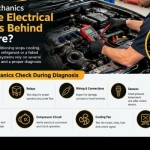


When your car air conditioning suddenly stops cooling, it is easy to assume that the refrigerant is low or the compressor has failed. However, modern vehicle air conditioning systems depend on several electrical components to operate correctly. A blown fuse, faulty relay, damaged wiring, failed sensor, weak voltage supply or control module problem can all prevent the AC from working.
Understanding how technicians diagnose these faults can help car owners recognise why proper testing matters. Professional car air conditioning repair is not simply about replacing the first component that appears faulty. It involves checking how the entire system communicates and operates.
Why Can an Electrical Fault Cause AC Failure?
Modern air conditioning systems use electrical signals to control compressors, blower motors, cooling fans, pressure sensors and climate control modules. If one part of the circuit fails, another component may not receive the signal or power it needs.
For example, the compressor may be mechanically healthy but fail to engage because of a faulty relay or pressure sensor. Similarly, a blower motor may work intermittently because of an electrical connection rather than a problem with the AC itself.
This is why car air conditioning specialists begin with diagnosis rather than immediately replacing major components.
How Do Mechanics Start Diagnosing an AC Electrical Problem?
The first step is usually understanding the driver's symptoms. A technician may ask when the AC stops working, whether it works intermittently, whether the fan operates and whether the problem changes when the vehicle is moving or stationary.
A visual inspection can then identify obvious problems such as damaged wiring, loose connectors, corroded terminals or blown fuses.
The technician may also check the vehicle's battery voltage and charging system. Low or unstable voltage can affect electronically controlled vehicle systems and create symptoms that appear to be related specifically to the AC.
A complete car air conditioning service should therefore consider the electrical supply as well as the refrigeration system.
What Role Do Fuses and Relays Play in AC Diagnosis?
Fuses protect electrical circuits from excessive current. If an AC fuse has failed, the affected component may stop operating completely.
Relays act as electrically controlled switches and can be used to operate components that require higher current. A failing relay may cause an AC system to work intermittently or prevent a component from receiving power.
Replacing a fuse or relay without investigating why it failed can leave the original problem unresolved. A technician should test the circuit and determine whether there is an underlying electrical fault.
How Do Mechanics Test AC Wiring and Electrical Connections?
Wiring connects the various AC components and allows electrical signals to travel between them. Heat, vibration, moisture and age can contribute to damaged wires or poor connections.
Technicians can use electrical testing equipment to check voltage, continuity and resistance within relevant circuits. They may inspect connectors for corrosion or loose terminals and compare electrical readings with the manufacturer's specifications.
These tests are particularly useful when a vehicle has an intermittent fault that cannot be identified through a basic visual inspection.
Complex vehicle climate control service may also require electronic diagnostic equipment to communicate with the vehicle's control modules.
Can Diagnostic Scanning Find an AC Electrical Fault?
Many modern vehicles contain electronic control modules that monitor and manage climate control functions. When a sensor or electronically controlled component develops a problem, the vehicle may store a diagnostic trouble code.
A scan tool can retrieve these codes and provide useful information about the affected circuit or component. However, a fault code does not always mean that the named component needs replacement.
A technician should use the code as a starting point and perform additional testing to confirm the actual cause. This approach is especially important during automotive climate control repair, where several components may interact.
How Do Mechanics Check the AC Compressor Circuit?
The compressor requires the correct electrical command before it can operate. Depending on the vehicle, the system may monitor refrigerant pressure, engine conditions and other parameters before allowing the compressor to engage.
A technician can check whether the compressor is receiving the required electrical signal and whether the clutch or electronically controlled compressor responds correctly.
If power is reaching the compressor but it does not operate as expected, further mechanical testing may be required. If power is missing, the technician can trace the circuit back through relevant relays, sensors, wiring and control systems.
Why Is the Cooling Fan Checked During AC Diagnosis?
The condenser needs adequate airflow to release heat from the refrigerant. The electric cooling fan helps provide this airflow, particularly when the vehicle is stationary.
If the fan does not operate correctly, the AC may become warm while idling or in slow traffic even though it cools reasonably well while driving.
Technicians can test the fan motor, relay, fuse, wiring and control signal to determine why it is not operating correctly.
This is one reason a best car AC repair Perth service should investigate connected systems instead of focusing only on refrigerant levels.
When Should You Visit a Car AC Specialist?
Professional inspection is appropriate when the AC stops working, operates intermittently, produces weak airflow or becomes warm without an obvious explanation.
A car AC repair specialist Perth drivers choose should be able to investigate both electrical and mechanical causes. The same symptoms can sometimes be produced by completely different faults, making accurate diagnosis important.
For drivers looking for auto AC repair Perth, the technician should ideally inspect the relevant electrical circuits before recommending component replacement.
How Can the Right Mechanic Prevent Misdiagnosis?
Good diagnosis follows a logical process. The technician identifies the symptoms, checks the electrical supply, inspects relevant circuits, scans electronic systems where appropriate and tests individual components.
An experienced car AC mechanic Perth drivers can rely on should explain what has been found and why a particular repair is necessary.
For complex electrical faults, an auto AC mechanic Perth may need to combine electronic diagnostics with traditional electrical testing.
Choosing an experienced auto repair shop is particularly important when the AC problem may involve the vehicle's broader electrical or cooling systems.
What Should Perth Drivers Do When Their AC Fails?
Do not assume that every AC failure requires refrigerant or compressor replacement. Electrical faults can produce similar symptoms and may be relatively hidden.
If your air conditioning stops working, becomes unreliable or behaves differently from normal, arrange a proper inspection. A technician providing best auto repair in Perth should investigate the cause systematically rather than relying on guesswork.
The most important point is simple: an AC failure is a symptom, not necessarily the diagnosis. Accurate electrical testing can reveal whether the problem lies with a fuse, relay, wiring connection, sensor, fan, compressor circuit or control system. Finding the actual cause allows the appropriate repair to be carried out and helps keep your vehicle's air conditioning operating as it should.