

The rapid adoption of smartphones, smart wearables, connected vehicles, IoT equipment, and other battery-powered electronics is increasing demand for compact and efficient power-management technologies across North America. Wireless charging is becoming an important feature in consumer and automotive electronics because it can simplify device design, reduce dependence on physical connectors, and improve user convenience. The US, in particular, benefits from a strong semiconductor design ecosystem and substantial investment in advanced electronics and chip technologies.
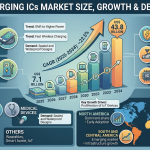
The Wireless Charging ICs Market Size is expected to increase from US$7.41 billion in 2025 to US$45.35 billion by 2034, registering a CAGR of 22.30% from 2026 to 2034. With an addressable opportunity of US$208.12 billion during 2026–2034, North America is positioned as an important region for technology development and adoption. The US semiconductor industry generated US$425 billion in sales in 2025 and accounted for 53.4% of global semiconductor sales, according to the Semiconductor Industry Association (SIA), providing a strong technology ecosystem for advanced IC development.
Download Sample PDF: https://www.theinsightpartners.com/sample/TIPRE00008293
North America Wireless Charging ICs Market Drivers
A major factor supporting demand in North America is the region's large consumer electronics ecosystem. US consumers have rapidly adopted smartphones, wireless earbuds, smartwatches, tablets, and other connected devices that increasingly incorporate wireless charging functionality. These applications require ICs capable of controlling power reception, voltage regulation, charging communication, thermal protection, and foreign-object detection.
The continued evolution of premium electronic devices is also encouraging manufacturers to integrate more sophisticated power-management components. As product designers seek thinner form factors and improved charging experiences, highly integrated wireless charging ICs can help reduce component count and optimize the use of limited circuit-board space.
Strong US Semiconductor Ecosystem Supports Innovation
The US has a significant advantage in semiconductor research, design, and innovation. SIA reported that US-headquartered semiconductor companies invested US$76.8 billion in R&D during 2025, highlighting the scale of the country's technology-development ecosystem. Since 2020, semiconductor companies have also announced more than US$770 billion in private-sector investments across 160 projects in 30 states, strengthening domestic capabilities spanning chip design, manufacturing, materials, packaging, and research.
This ecosystem can support continued innovation in wireless power-management technologies. For wireless charging IC suppliers, access to semiconductor design expertise, electronics manufacturers, research institutions, and automotive technology companies creates opportunities to develop application-specific solutions for increasingly demanding power requirements.
Automotive Applications Create New Opportunities
Automotive electronics represent another important growth opportunity across the US and wider North American region. Modern vehicles increasingly incorporate smartphone charging systems, connected infotainment, and advanced electronic architectures. Wireless charging ICs can support these applications by controlling power delivery and maintaining charging performance under automotive operating conditions.
Technology suppliers are already developing automotive-qualified wireless receiver ICs. For example, Texas Instruments offers automotive wireless power receiver ICs compliant with Wireless Power Consortium specifications, including integrated power-management and communication functions.
The expansion of electric vehicles could provide an additional long-term opportunity. Wireless charging for EVs remains an evolving technology, but developments in inductive and magnetic-resonance charging are supporting research and deployment initiatives. TI has highlighted the development of wireless EV charging infrastructure and the emergence of North American and international standards for wireless charging.
IoT and Connected Devices Drive Demand
The increasing deployment of IoT devices throughout North American homes, businesses, healthcare facilities, warehouses, and industrial environments is another significant driver. Many connected devices require compact power solutions and may operate in locations where conventional wired charging is inconvenient.
Wireless charging ICs can help enable low-power and compact charging architectures for sensors, smart-home devices, medical electronics, industrial equipment, and other connected products. As manufacturers seek to reduce maintenance requirements and simplify device installation, wireless power technologies can become increasingly relevant.
Advancements in Power Efficiency and Integration
Technological advancement remains central to the expansion of wireless charging IC applications. Manufacturers are focusing on improving energy efficiency, power density, thermal management, charging speed, communication capabilities, and system integration.
For North American device manufacturers, these improvements can support the development of smaller and more sophisticated products. Automotive applications require particularly robust solutions capable of operating across demanding temperature and reliability conditions. Automotive-qualified wireless receiver ICs already demonstrate features such as thermal shutdown, dynamic efficiency scaling, foreign-object detection, and integrated communication control.
Top Players
The competitive landscape includes major semiconductor and electronics technology companies such as Texas Instruments Incorporated, Renesas Electronics Corporation, STMicroelectronics, Infineon Technologies AG, NXP Semiconductors N.V., Analog Devices, Inc., Microchip Technology Inc., onsemi, Qualcomm Technologies, Inc., and ROHM Co., Ltd.
These companies are developing wireless power transmitters, receivers, power-management ICs, and related semiconductor solutions for consumer electronics, automotive, industrial, and IoT applications. Product integration, efficiency improvements, automotive qualification, and compatibility with wireless charging standards remain important areas of technological development.
North America Future Outlook
North America's wireless charging IC landscape is expected to benefit from continued adoption of connected electronics, automotive electrification, wearable devices, and IoT technologies. The US semiconductor ecosystem is also undergoing substantial expansion, with investments aimed at strengthening domestic manufacturing and research capabilities. SIA reports that announced investments since 2020 are expected to help significantly expand US chipmaking capacity by 2032.
Through 2034, opportunities are likely to emerge around faster charging, higher power efficiency, miniaturized IC architectures, automotive-grade components, improved thermal management, and greater interoperability. The combination of strong semiconductor R&D capabilities, expanding electronics applications, and investment in domestic chip infrastructure provides an important foundation for continued innovation in wireless charging IC technologies across North America.
About The Insight Partners
The Insight Partners is a globally recognized market research and consulting firm providing reliable and actionable insights across numerous industries. Its research helps businesses, investors, and industry professionals understand emerging technologies, industry trends, competitive landscapes, and growth opportunities.
Contact Us
The Insight Partners
Email: sales@theinsightpartners.com
Phone: +1-646-491-9876
Website: https://www.theinsightpartners.com
Related Reports -
Submarine Fiber Cable Market Demand, Share & Growth by 2034
Aircraft Wiring Harness Market Dynamics and Trends by 2030
SCADA Oil and Gas Market Size, Trends & Growth by 2034
Contact Us
The Insight Partners
Email: sales@theinsightpartners.com
Phone: +1-646-491-9876
Website: https://www.theinsightpartners.com
Related Reports -
Submarine Fiber Cable Market Demand, Share & Growth by 2034
Aircraft Wiring Harness Market Dynamics and Trends by 2030
SCADA Oil and Gas Market Size, Trends & Growth by 2034