
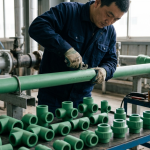

Modern plumbing systems require materials that can handle regular water flow, temperature changes, pressure, and long-term use. PPR has become a popular choice for many plumbing and water distribution applications because of its practical performance and installation advantages.
Along with PPR pipes, ppr pipe fittings play an important role in creating complete piping networks. Fittings connect pipes, change flow direction, create branches, and help connect different components within a system.
What Are PPR Pipe Fittings?
PPR fittings are components manufactured from polypropylene random copolymer and designed to work with compatible PPR piping systems.
They are available in different shapes and sizes to meet various installation requirements. Depending on the application, fittings can be used for straight connections, bends, branches, transitions, and equipment connections.
One of the common installation methods is heat fusion. The pipe and fitting are heated using suitable equipment and then joined together. When properly installed, the connection forms a continuous joint.
Common Types of PPR Fittings
There are several types of fittings used in PPR plumbing systems.
Elbows are used when the pipeline needs to change direction. They are commonly available in 45-degree and 90-degree configurations.
Tees are used to create a branch from the main pipeline. They are useful when water needs to be distributed to different sections of a building.
Couplers connect two sections of PPR pipe in a straight line.
Reducers connect pipes with different diameters and help accommodate changes in the piping network.
Unions and threaded fittings can be used where detachable connections or connections to other components are required.
Benefits of PPR Fittings
One important benefit of PPR systems is their resistance to corrosion. Unlike some traditional metal piping materials, PPR does not rust, making it suitable for many water supply applications.
PPR fittings are also relatively lightweight, which can make transportation and handling easier during installation.
Another advantage is the heat-fusion joining method. When properly performed, the fused connection can provide a strong and reliable joint with reduced risk of leakage.
PPR systems can also provide smooth internal surfaces, supporting efficient water flow and helping reduce areas where deposits may accumulate.
Applications of PPR Pipe Fittings
ppr pipe fittings are commonly used in residential, commercial, and industrial plumbing projects.
Typical applications include:
- Hot and cold water systems
- Residential plumbing
- Commercial buildings
- Hotels and hospitality projects
- Hospitals
- Schools and institutions
- Industrial water systems
- Heating applications
- Water distribution networks
The exact application depends on the specifications of the pipe and fitting system.
Factors to Consider When Choosing Fittings
Choosing the correct fitting is important for system performance. The pipe diameter should match the fitting size, and the fitting should be compatible with the specific PPR piping system.
Operating temperature and pressure should also be considered, particularly in hot-water applications.
The quality of manufacturing and dimensional accuracy are important because poor-quality fittings may create installation difficulties or affect joint performance.
It is also essential to use suitable installation equipment and follow recommended fusion procedures.
Installation Best Practices
Proper installation is just as important as choosing good-quality fittings. Pipe ends should be clean and properly prepared before fusion.
The heating equipment should reach the recommended temperature, and the pipe and fitting should be inserted to the correct depth. Excessive force or incorrect heating can affect the joint.
After completing the installation, the system should be inspected and pressure tested according to the applicable project requirements.
Conclusion
ppr pipe fittings are an important part of modern plumbing systems, helping create reliable networks for water distribution and other applications. Their corrosion resistance, lightweight construction, and heat-fusion joining method make them a practical option for many projects.
Selecting compatible fittings, following proper installation procedures, and considering operating conditions can help improve the reliability and service life of a PPR piping system.