
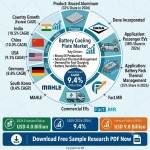


The battery cooling plate market is forecast to grow at a 9.4% CAGR from 2026 to 2036, driven by electric vehicle production and rising thermal-management requirements.
October 10, 2026 — The global battery cooling plate market is projected to reach USD 9.8 billion by 2036, rising from USD 4.0 billion in 2026 at a compound annual growth rate (CAGR) of 9.4%, according to Fact.MR. The market was valued at USD 3.6 billion in 2025. Fact.MR estimates an absolute opportunity of USD 5.8 billion between 2026 and 2036 as electric vehicle (EV) manufacturers adopt advanced battery thermal-management systems to control temperatures, support faster charging, and improve battery durability.
The demand outlook reflects a practical engineering challenge. As EV battery packs become larger and charging requirements increase, manufacturers need cooling structures that remove heat without adding excessive weight or restricting coolant flow. Fact.MR's analysis identifies India as the fastest-growing market among the five highlighted countries, with a projected CAGR of 10.5% through 2036.
Get detailed market forecasts, competitive benchmarking, and pricing trends: https://www.factmr.com/connectus/sample?flag=S&rep_id=15036
Battery Cooling Plate Market Growth Reflects Changing EV Requirements
Battery cooling plates are heat-transfer structures installed within electric and hybrid vehicle battery packs. These components draw heat away from battery cells and transfer it to circulating coolant through internal channels, helping maintain operating temperatures within desired limits.
According to the National Renewable Energy Laboratory (NREL), battery thermal management helps minimize cell-to-cell temperature variation while supporting battery reliability, safety, and driving range. The technical requirement becomes more demanding as manufacturers seek higher energy density and shorter charging times.
MAHLE's battery cooling plate materials state that lithium-ion cells are temperature-sensitive and should remain below 40°C over extended periods. This temperature constraint helps explain why cooling performance is increasingly relevant to battery design decisions rather than being treated as a secondary hardware consideration.
The market is expected to generate USD 5.8 billion in additional value between 2026 and 2036. This forecast reflects expanding EV production, wider adoption of liquid-cooled battery packs, and demand for cooling architectures that can manage heat during charging and vehicle operation.
Brazed Aluminum Cooling Plates Lead Product Demand
Brazed aluminum cooling plates are estimated to account for approximately 32% of the market in 2026, making them the leading product category in Fact.MR's analysis. Their position reflects the combination of low weight, thermal conductivity, and manufacturing suitability required for automotive battery applications.
Dana Incorporated describes its battery cold plates as lightweight aluminum structures designed to stabilize cell temperatures and improve temperature uniformity. Modine Manufacturing Company also identifies aluminum-based cooling plates with serpentine and rectangular coolant-channel designs as established approaches to battery heat management.
Manufacturers are evaluating plate designs based on more than heat transfer alone. Coolant pressure loss, packaging space, material weight, and integration with battery packs influence the suitability of different architectures. Flexible and conformal plates may also serve applications requiring closer contact with different battery cell formats.
The choice of cooling architecture therefore depends on pack design and operating requirements. Suppliers that can demonstrate thermal performance alongside integration benefits may be better positioned to address specific vehicle-platform needs.
Passenger EVs Account for the Largest Vehicle Segment
Battery electric passenger cars are projected to represent approximately 38% of the market in 2026. Their expected share reflects the need for active thermal management across passenger EV battery packs, where charging performance, usable energy, and long-term battery health remain important engineering considerations.
Electric SUVs present additional cooling requirements because larger battery packs can increase thermal loads. Commercial electric vehicles also require careful temperature control, particularly where demanding duty cycles and repeated charging place greater stress on battery systems.
By application, battery pack thermal management is expected to hold approximately 35% share in 2026. Cooling plates perform their central function within this segment by helping stabilize cell temperatures during charging, discharging, and vehicle operation.
Fast-charging support remains another relevant application. Effective heat removal can help manufacturers manage temperature increases during charging, although actual charging performance also depends on battery chemistry, charging infrastructure, software controls, and the wider thermal-management system.
India Leads Country-Level Growth Through 2036
Fact.MR's country forecasts show India leading the five highlighted markets, with a projected CAGR of 10.5% from 2026 to 2036. Expanding EV localization and growing domestic battery manufacturing capacity support the country's outlook.
China follows at 10.0%, supported by large-scale EV production and established battery-pack integration capabilities. The United States is projected to grow at 9.3%, while Germany records an estimated CAGR of 8.8%. South Korea follows at 8.4%, reflecting its advanced battery technology ecosystem and thermal-management capabilities.
These figures are model-based estimates from Fact.MR's analysis, updated May 14, 2026. The report covers North America, Europe, Asia Pacific, Latin America, and the Middle East and Africa, assessing demand patterns across more than 40 countries.
Suppliers Face Design and Integration Trade-Offs
Shambhu Nath Jha, an analyst at Fact.MR, said, “This market should be viewed as a battery performance and durability category rather than a narrow thermal hardware segment. Buyers are not only paying for heat extraction. They are paying for improved charging behavior, extended battery life, and tighter pack temperature control.”
The competitive landscape includes Dana, MAHLE, Modine, Miba, Hanon Systems, and participants in the Valeo, Sanhua, and Boyd thermal-management ecosystems. Competition depends on heat-transfer efficiency, pressure-drop control, lightweight construction, and compatibility with different battery-pack architectures.
Fact.MR's analysis also identifies a key commercial challenge: improved cooling performance can increase manufacturing complexity and require careful coolant routing and system integration. Suppliers must show how their designs address these trade-offs in actual battery applications.
Shambhu Nath Jha added, “The engineering details matter. A plate has to fit the pack, manage heat properly, and work with the wider cooling system. That's where the value becomes clearer.”
Battery Cooling Plate Market Forecast and Research Scope
Fact.MR is a market research and consulting company that provides industry forecasts, competitive analysis, and strategic intelligence to help businesses evaluate market opportunities.
The battery cooling plate market report examines forecasts from 2026 to 2036, with segmentation by product type, vehicle type, application, integration type, and region. Its methodology combines top-down and bottom-up market modelling with primary interviews involving thermal engineers, battery-pack designers, vehicle manufacturers, sourcing teams, and cooling-system suppliers. Desk research includes technical materials from NREL, Dana, MAHLE, and Modine.
View Related Reports :
https://ayushjadhavblogs.blogspot.com/2026/10/infant-nutrition-market-to-reach-usd.html
https://1nigeria.radiobenue.be.gov.ng/read-blog/36455
About Fact.MR
Fact.MR is a market research and consulting firm that provides market intelligence, industry forecasts and strategic analysis to support business decision-making. Its research combines primary interviews, company disclosures, pricing reviews and proprietary forecasting models.
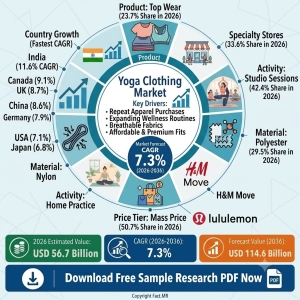
The Yoga Clothing Market Report covers global and regional forecasts from 2026 to 2036, with analysis by product, material, end user, price tier, distribution channel and activity format. The study examines more than 40 country-level markets and profiles companies including lululemon athletica inc., Alo Yoga LLC, Athleta LLC, Beyond Yoga, Nike Inc., Adidas AG, H&M Move and Vuori Inc.