
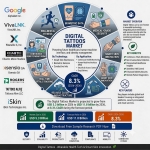



The global digital tattoos market is projected to reach USD 5.3 billion in 2026 and expand to USD 11.8 billion by 2036, registering a compound annual growth rate (CAGR) of 8.3%, according to Fact.MR. Growing demand for continuous physiological monitoring and lightweight wearable technologies is creating opportunities for biosensor developers and medical technology companies.
Digital tattoos are ultra-thin electronic patches that attach directly to the skin to monitor signals such as heart rate, body temperature, hydration, and muscle activity. Their applications span healthcare monitoring, sports performance tracking, and biomedical research.
Get detailed market forecasts, competitive benchmarking, and pricing trends: https://www.factmr.com/connectus/sample?flag=S&rep_id=14619
Graphene-Based Sensors Drive Market Demand
Graphene tattoos are projected to account for approximately 40% of the market by type in 2026. Their flexibility and electrical conductivity support the development of skin-mounted sensors designed to capture physiological signals.
Medical applications are expected to represent around 35% of the market, supported by demand for continuous patient monitoring and non-invasive diagnostic technologies. Research institutions and healthcare technology developers are exploring these devices for clinical studies and remote monitoring applications.
Healthcare Monitoring Expands Opportunities
Digital tattoos offer an alternative to bulkier monitoring equipment by enabling lightweight sensors to maintain contact with the skin. Improvements in flexible electronics and wireless data transmission could expand their use across clinical and research environments.
However, device durability, manufacturing complexity, regulatory approvals, and skin compatibility remain important challenges for commercial adoption.
South Korea Leads Country-Level Growth
South Korea's digital tattoos market is projected to grow at a CAGR of 10.3% through 2036, followed by the United Kingdom at 9.8%. The United States is forecast to register a CAGR of 7.9%, while Japan is expected to grow at 6.2%.
Investment in wearable electronics, biomedical research, and flexible sensor technologies is supporting development across these markets. Regulatory compliance and improvements in sensor reliability will influence the pace of healthcare adoption.
Analyst Perspective
Shambhu Nath Jha, Principal Consultant at Fact.MR, observes that wearable biosensor technologies are expanding across healthcare monitoring and biomedical research. Companies developing advanced materials and flexible electronic sensors are positioned to benefit as applications evolve.
Competitive Landscape
Competition centres on sensor accuracy, material flexibility, durability, and integration with digital health platforms. Key companies profiled in the Fact.MR report include Google LLC (Alphabet Inc.), VivaLNK, Inc., Wearable X, Inc., Chaotic Moon Studios, Xsensio SA, Rogers Corporation, Tattoos Alive LLC, and iSkin Technologies Inc.
Market participants are focusing on flexible materials, biosensor innovation, and collaborations with healthcare technology developers.
Market Snapshot
- Estimated market value (2026): USD 5.3 billion
- Forecast market value (2036): USD 11.8 billion
- CAGR (2026–2036): 8.3%
- Leading type segment: Graphene tattoos, with approximately 40% share
- Leading application: Medical, with approximately 35% share
- Fastest-growing profiled country: South Korea, at 10.3% CAGR
To View Related Reports
https://afgbfh.blogspot.com/2026/10/high-purity-polyglutamic-acid-market.html
https://sportgalax.com/read-blog/26033
About Fact.MR
Fact.MR is a market research and competitive intelligence provider delivering market intelligence, competitive analysis, and forecasting across global industries. Its research helps businesses evaluate market demand, understand competitive developments, and identify growth opportunities.