


Hot stamping foil is widely used in the furniture industry to apply decorative patterns or metallic finishes onto MDF surfaces. This technique offers precise and consistent decoration while maintaining production efficiency.
Material Composition of Hot Stamping Foil
Hot stamping foil typically consists of multiple layers, including a carrier film, release layer, color or metallic layer, and adhesive layer. The carrier film supports the foil during transfer. The adhesive layer is activated by heat and pressure, allowing the color or metallic layer to bond to the MDF surface. Each layer plays a specific role in ensuring the pattern transfers clearly and uniformly.
Surface Preparation of MDF
Before hot stamping, MDF panels must be properly prepared. This includes sanding to smooth the surface, cleaning to remove dust and debris, and sometimes applying a primer or base coating. A well-prepared surface improves adhesion and helps prevent defects such as incomplete transfer, bubbling, or uneven finish.
Hot Stamping Process
The core principle involves applying heat and pressure to the foil on the MDF surface. A hot stamping machine uses a heated die to press the foil against the board. Heat activates the adhesive layer, and pressure ensures close contact, allowing the color or metallic layer to transfer accurately. The die design determines the pattern, shape, and positioning of the decoration.
Cooling and Inspection
After stamping, the MDF panel is cooled to allow the adhesive to set. Once cooled, the surface is inspected for consistency, clarity, and adhesion. Any irregularities can indicate adjustments needed in temperature, pressure, or die alignment for subsequent production runs.
By following these steps, hot stamping foil can provide MDF furniture with decorative finishes that combine durability, visual appeal, and production efficiency.
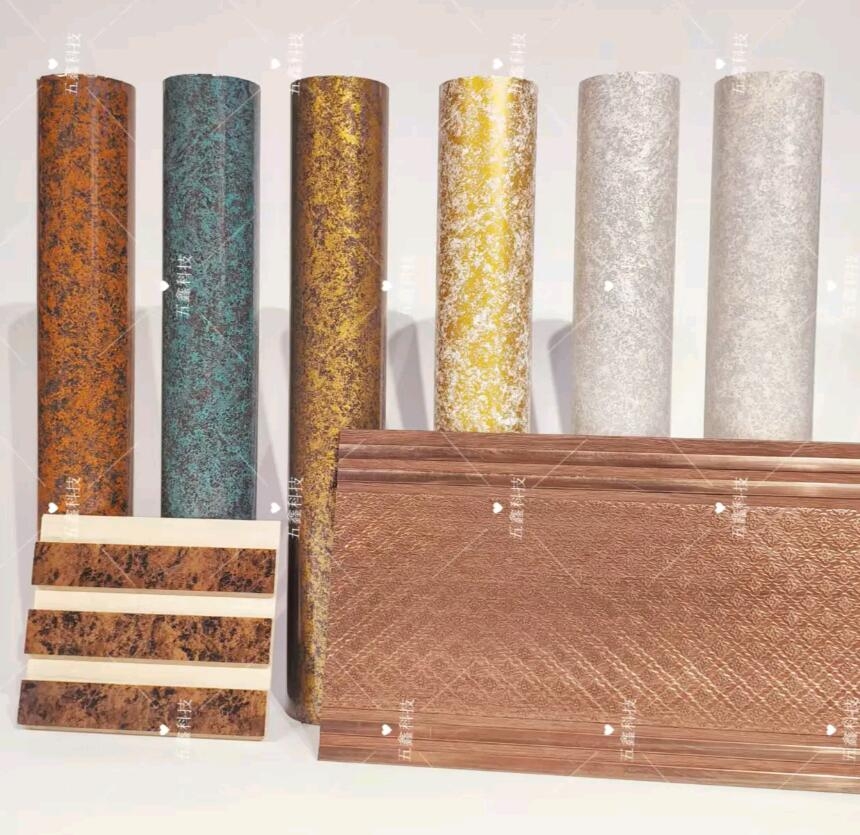
https://www.wuxintransfer.com/product/hot-stamping-foil-for-wpc-pvc-doors/retro-mottled-and-rusted-texture-heat-transfer-film.html
This heat transfer film from Wuxin Technology features a retro, mottled and rusted texture pattern, and comes in a variety of color tones including brownish, dark green, gold and silver. It is scratch-resistant, water-resistant and sun-resistant. It is compatible with decorative panels made of materials such as ABS, WPC and PP, and can also be used for surface decoration of stone plastic lines, endowing these base materials with a accumulated retro texture and adding a naturally aged layer to the decorative surface.