
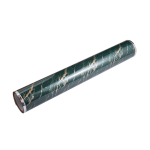




The use of PS Hot Stamping Foil alongside Heat Resistant Hot Stamping Foil has become increasingly common across printing, packaging, and surface decoration processes that require controlled heat transfer and consistent adhesion. Rather than being selected for visual appeal alone, these materials are typically chosen based on substrate compatibility, temperature tolerance, and production stability during repeated stamping cycles.
Hot stamping relies on a balance between heat, pressure, and dwell time. When these elements are aligned correctly, the foil layer transfers cleanly from its carrier film onto the target surface. PS Hot Stamping Foil is often associated with polystyrene-based substrates or surfaces with similar thermal characteristics. Its formulation is designed to soften and release at defined temperature ranges, allowing controlled transfer without excessive deformation of the base material.
Heat Resistant Hot Stamping Foil serves a different but complementary purpose. It is developed for applications where higher operating temperatures or prolonged heat exposure are expected. This includes scenarios such as continuous production lines or substrates that require elevated temperatures to achieve proper adhesion. The heat resistance helps maintain foil integrity during transfer, reducing issues such as discoloration or incomplete release.
Material compatibility plays a central role in foil performance. Substrates vary widely, ranging from plastics and coated papers to synthetic composites. PS Hot Stamping Foil tends to perform consistently on materials with predictable thermal responses, where heat absorption and surface softening occur within narrow ranges. Heat Resistant Hot Stamping Foil accommodates substrates that demand more thermal energy before bonding occurs.
Process consistency is influenced by foil structure. Most hot stamping foils consist of multiple layers, including a carrier film, release layer, decorative or functional layer, and adhesive layer. The balance between these layers determines how the foil reacts under heat and pressure. Heat Resistant Hot Stamping Foil often features reinforced layers designed to maintain stability when exposed to sustained heat.
Operational efficiency benefits from predictable foil behavior. When transfer occurs evenly, fewer adjustments are needed during production. This reduces downtime and material waste. PS Hot Stamping Foil supports stable output when temperature controls are well calibrated, while heat resistant variants provide a wider processing window under demanding conditions.
Surface finish quality depends on clean separation from the carrier film. Uneven release can result in incomplete patterns or edge distortion. Foils formulated for heat resistance help maintain clean edges even when higher temperatures are necessary. This consistency supports detailed designs without relying on excessive pressure.
Environmental factors also influence foil choice. Ambient temperature, humidity, and production speed can all affect transfer quality. Heat Resistant Hot Stamping Foil offers greater tolerance under fluctuating conditions, while PS Hot Stamping Foil performs well in controlled environments where parameters remain stable.
Maintenance considerations should not be overlooked. Equipment used with hot stamping foils benefits from consistent operating temperatures and clean surfaces. Foils that transfer efficiently reduce residue buildup on stamping dies, supporting longer tool life and smoother operation.