
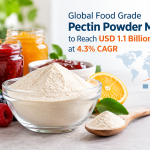



The global food-grade pectin powder market supplies natural hydrocolloid ingredients used as gelling agents, stabilizers and thickeners in food and beverage manufacturing. Pectin is extracted primarily from citrus peels and apple pomace, and powder forms offer handling and solubility advantages compared with liquid variants.
According to 24ChemicalResearch, the market reached USD 731.0 million in 2025 and is estimated at USD 762.5 million in 2026. It is forecast to reach USD 1.1 billion by 2034, representing a CAGR of 4.3% during 2026–2034. Europe was the largest region, with an estimated 34% of 2025 global market value.
Read the complete Global Food Grade Pectin Powder Market report:
https://www.24chemicalresearch.com/reports/282367/global-food-grade-pectin-powder-market
Food-Grade Pectin: Formulation and Functional Performance
Pectin selection depends on the final recipe and required gel behavior. High-methoxyl pectin is suited to conventional high-sugar preserves, while low-methoxyl pectin supports calcium-managed systems. Amidated low-methoxyl pectin offers different thermal reversibility and texture characteristics. Extraction and standardization technology helps food manufacturers reproduce viscosity, mouthfeel and shelf stability across production batches.
The market’s demand base includes fruit preparations, dairy textures, baked fruit fillings and plant-based food formulations. Citrus-based pectin represented a major source in the market, while manufacturers continue to assess feedstock availability, product specifications and application performance.
What Is Driving Market Growth?
Demand for clean-label and natural ingredients supports pectin adoption as food manufacturers consider plant-based alternatives to synthetic additives and stabilizers. Pectin is used in jams, dairy alternatives and confectionery, where formulation performance and recognizable ingredients are important considerations.
Expansion of plant-based dairy alternatives provides another demand channel. Pectin can function as a stabilizer and texture modifier in almond, soy and oat milk products, helping improve mouthfeel and prevent ingredient separation. Low-methoxyl varieties also support use in some neutral-pH applications.
The report identifies bakery as a significant application and beverages as a faster-growing application area. Pharmaceutical use, including drug-delivery systems, edible films, controlled-release matrices, vegan capsules and wound dressings, is also discussed as an opportunity.
Raw Materials, Production and Market Challenges
The pectin supply chain depends on agricultural byproducts, particularly citrus peel and apple pomace. Weather volatility and changes in fruit yields can affect raw-material availability and pricing. Producers may need inventory buffers, while raw-material price changes can influence margins and retail pricing.
High-methoxyl pectin’s functionality depends on sucrose concentration, creating a technical limitation in reduced-sugar applications. Alternative hydrocolloids may be needed in some formulations, adding cost. Amidated low-methoxyl pectin offers potential in sugar-free products, although regulatory limits in certain markets and flavor considerations can affect adoption.
Competition from carrageenan, xanthan gum and other hydrocolloids creates additional margin pressure. Regulatory differences across regions can complicate product launches because permitted uses and classification requirements are not uniform.
Read the full report for key data:
https://www.24chemicalresearch.com/reports/282367/global-food-grade-pectin-powder-market
Food Grade Pectin Powder Market Segmentation
The report evaluates the market by type, application, source and distribution channel.
By type, the market includes:
- High Methoxyl Pectin (HM)
- Low Methoxyl Pectin (LMC)
- Amidated Low Methoxyl Pectin (LMA)
High Methoxyl Pectin was the leading type, accounting for an estimated 56% of 2025 market value.
By application, the market covers baked goods, dairy products, drinks, jam and other applications. Jam represented an estimated 36% of 2025 value. By source, the report covers citrus fruits, apple pomace and other plant sources. Distribution channels include direct industrial contracts, ingredient distributors and specialty packaged trade.
Regional Outlook and Competitive Landscape
Europe led the market with an estimated 34% share in 2025, supported by packaged-food and specialty hydrocolloid manufacturing. North America, Asia-Pacific, South America and the Middle East & Africa are also covered. The report notes activity among manufacturers and ingredient suppliers serving different formulation requirements.
Key companies profiled include Tate & Lyle (CP Kelco), Cargill, Herbstreith & Fox, JRS Silvateam Ingredients, CEAMSA and dsm-firmenich. The report describes Tate & Lyle’s acquisition of CP Kelco and Cargill’s investment in Brazilian pectin processing. In the European Union, pectin carries food additive code E440 and is subject to specification and safety requirements.
The market’s commercial considerations include seasonal feedstock availability, extraction energy requirements, batch variation, additive documentation and verified application performance.
About 24 Chemical Research
24 Chemical Research specializes in chemical and materials market intelligence, covering specialty chemicals, polymers, surfactants, advanced materials and related industrial markets. Its research combines market sizing and forecasting with analysis of production, capacity, pricing, trade flows, applications, suppliers, regional demand and competitive positioning.
Read the full report for key data:
https://www.24chemicalresearch.com/reports/282367/global-food-grade-pectin-powder-market
Download a free Report sample:
https://www.24chemicalresearch.com/download-sample/282367/global-food-grade-pectin-powder-market
Contact 24 Chemical Research
Phone: +91 9169162030
Email: help@24chemicalresearch.com
Website: www.24chemicalresearch.com