
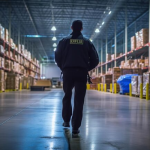






Warehouse security has a reputation for being straightforward. The building is large, mostly empty of people, and surrounded by fences. In practice it is one of the harder commercial properties to cover, because the inventory is valuable, the access points are numerous, and a meaningful share of the loss involves people who are supposed to be there.
Here is where warehouse loss actually comes from and what coverage addresses each part.
The Loss Is Rarely a Break-In
Owners usually plan for the overnight intruder. That scenario happens and it is not where most inventory goes.
Loss at distribution facilities concentrates in a few places. Product leaves on trucks in quantities that were never ordered. Pallets get staged near a dock and loaded onto the wrong vehicle. Items disappear during shift changes, when attention is split and the parking lot fills with people coming and going. Returns and damaged goods, which sit outside normal inventory controls, walk off quietly.
The common thread is that most of it happens during operating hours and involves access that was legitimately granted. That changes what coverage needs to look like.
The Loading Dock Is the Primary Exposure
Docks are where a warehouse is most open, and where the most value moves in the shortest time.
Several things make them difficult. Doors stand open for long periods. Drivers who are not employees move through the area. Paperwork gets checked quickly under schedule pressure. Product sits staged and unattended between being picked and being loaded.
Coverage at the dock is mostly verification rather than deterrence. An officer checking that the vehicle at the door matches the scheduled pickup, that the driver is who the paperwork says, and that the load leaving matches the manifest catches the category of loss that cameras record and nobody reviews.
Seal checks matter here as well. Confirming and documenting seal numbers on arrival and departure is simple work that closes a gap most facilities leave open, and it costs nothing beyond asking for it in the post orders.
Gate Control
For facilities with a yard, the gate is the most useful single position.
Officers log vehicles in and out, check driver identification against expected deliveries and pickups, direct trucks to the correct door, and turn away anyone without a reason to be on site. That log becomes valuable the moment something is missing, because it narrows a question that is otherwise unanswerable.
Gate coverage also handles the yard itself. Trailers staged overnight, equipment left out, and fuel stored on site are all targets, and a yard without a gate position is open to anyone who drives in behind a legitimate truck. Fuel in particular disappears in small amounts over long periods, which is why most facilities only discover it during an audit.
Employee Access & Shift Change
This is the uncomfortable part of warehouse security and the one owners most often skip.
Internal loss at distribution facilities is significant, and it concentrates around shift changes, personal vehicle access near the building, and areas where product can be staged out of sight.
The measures that work are administrative more than protective. Employee parking positioned away from the building rather than beside a dock. A single staffed exit for personnel rather than several unwatched ones. Officers present at shift change simply because presence changes behavior. Bag and package checks where the facility's policy provides for them, applied consistently to everyone rather than selectively.
That last point matters legally as much as practically. Any inspection policy needs to be written, applied uniformly, and reviewed by counsel before it starts.
High-Value Areas
Most warehouses have a cage or a secured section for the product that attracts attention, including electronics, pharmaceuticals, tools, and anything small with resale value.
Coverage there is about access logging rather than patrol, meaning a record of who entered, when, and with what authorization. A cage with a lock and no record of who opened it provides very little, since the people with keys are the people most able to use them quietly.
After-Hours Coverage
Once the facility closes, the exposure shifts to perimeter and structure.
Patrol rounds covering the fence line, dock doors, roof access, trailer yard, and any outbuilding address this at a cost that makes sense for a property with nobody in it. Randomized timing matters more than frequency, since anyone watching a facility learns a fixed schedule in a few nights.
Officers on these rounds should be checking physical conditions as well, including fence damage, failed lighting, doors that are not latching, and trailers parked where they should not be. Coverage models built this way start from how a facility actually operates rather than from an hours template.
That is the approach God's Armour Security takes with industrial and warehouse accounts in Houston, where its commercial coverage range is set against the site rather than a standard schedule.
Documentation Is the Part That Pays Off
Warehouse loss is usually discovered in a count rather than in the moment. By the time anyone knows something is gone, the window is days or weeks wide. The records are the difference between an unexplained variance and an answerable question. Gate logs, dock verification records, seal numbers, and patrol reports let you reconstruct who was on site and what left. Without them, an inventory shortage has no starting point.
Reading those records matters as much as keeping them. Losses that cluster around a shift, a carrier, a door, or a day of the week show up in logs long before anyone identifies a cause.
Setting the Program
A workable warehouse arrangement usually combines a staffed gate or dock position during operating hours with patrol coverage after close. The daytime hours address verification and access. The overnight hours address perimeter and structure.
What makes it work is matching the coverage to where loss is actually occurring at your facility rather than to where owners generally assume it occurs. The inventory counts and the incident records will tell you which, and that is the right place to start before anyone quotes hours.