
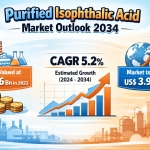

The global purified isophthalic acid (PIA) market is steadily evolving as industries increasingly prioritize high-performance materials and sustainable production models. With a market valuation of US$ 2.6 billion in 2023, the industry is forecast to reach US$ 3.9 billion by 2034, expanding at a compound annual growth rate (CAGR) of 5.2% from 2024 to 2034. This growth trajectory reflects strong demand across packaging, automotive, textiles, construction, and electronics sectors, all of which rely on advanced polymers enhanced by PIA.
Purified isophthalic acid has emerged as a critical chemical intermediate in the production of polyethylene terephthalate (PET) resins and other specialty polymers. As sustainability goals intensify worldwide and circular economy models gain traction, PIA’s importance in delivering durability, recyclability, and performance efficiency continues to grow.
Chemical Profile and Functional Advantages of Purified Isophthalic Acid
Purified isophthalic acid is an aromatic dicarboxylic acid derived from the controlled oxidation of meta-xylene. Its molecular structure allows it to modify polymer chains, enhancing thermal resistance, chemical stability, impact strength, and weather durability. These properties make it an indispensable co-monomer in high-performance polymer systems.
In PET resin production, PIA improves clarity, strength, and resistance to heat distortion. It also enhances hydrolytic stability in polyester fibers and resins. Beyond PET, PIA finds application in unsaturated polyester resins (UPR), alkyd resins, powder coatings, plasticizers, lubricants, and other specialty formulations.
Its compatibility with recycled PET (rPET) systems further strengthens its relevance in an era where sustainability and recyclability are becoming mandatory rather than optional.
Market Growth Drivers and Demand Catalysts
1. Surge in Sustainable Packaging Demand
Packaging remains the largest end-use segment for purified isophthalic acid. PET bottles and films dominate beverage, food, and consumer goods packaging due to their lightweight structure, clarity, and recyclability. As global governments and corporations commit to reducing carbon footprints and plastic waste, recyclable PET packaging has gained renewed focus.
Circular economy initiatives are accelerating rPET production, requiring high-quality PIA inputs to maintain structural integrity during repeated recycling cycles. Companies are investing heavily in recycling infrastructure, which indirectly boosts demand for PIA-enhanced resins.
Lightweight packaging not only reduces transportation costs but also lowers greenhouse gas emissions, reinforcing PET’s role in sustainable supply chains.
2. Automotive Lightweighting and Emission Regulations
The automotive industry continues to seek materials that reduce vehicle weight without compromising safety or performance. PIA-modified thermoplastics and polyester resins offer superior dimensional stability, heat resistance, and mechanical strength.
Lightweight polymers help manufacturers meet global emission reduction standards while improving fuel efficiency and electric vehicle battery performance. Applications include under-the-hood components, structural parts, coatings, and reinforced composites.
As electric vehicles expand globally, demand for high-performance plastics will likely rise, further driving purified isophthalic acid consumption.
3. Construction and Infrastructure Expansion
Urbanization and infrastructure modernization, particularly in emerging economies, have increased the need for durable, corrosion-resistant construction materials. PIA-based resins are used in protective coatings, pipes, insulation materials, and reinforced composites.
These materials offer improved weather resistance and longevity, making them suitable for infrastructure projects that prioritize durability and sustainability. The trend toward energy-efficient and green buildings further supports advanced polymer applications.
4. Growth in Textiles and Performance Fibers
Polyester fibers enhanced with PIA demonstrate improved flexibility, resilience, and tensile strength. These fibers are widely used in apparel, home textiles, and industrial fabrics. As global demand for functional textiles increases, including sportswear and technical fabrics, polyester production remains robust.
The integration of recycled polyester into textile supply chains adds another growth layer, reinforcing PIA’s long-term market relevance.
Application Segment Analysis
PET Production: The Dominant Application
PET production accounts for approximately 54.5% of total purified isophthalic acid consumption. Its dominance stems from extensive use in packaging bottles, films, and fibers.
PIA enhances PET’s heat distortion temperature, mechanical strength, and chemical resistance, allowing it to perform effectively in demanding applications. The shift toward sustainable packaging and recycled PET continues to secure PET’s position as the primary growth engine for the PIA market.
Unsaturated Polyester Resins (UPR)
UPR is another significant application segment, widely used in construction panels, marine components, automotive parts, and industrial equipment. PIA improves the corrosion resistance and structural integrity of these resins.
As demand for reinforced composites grows, especially in renewable energy and transportation sectors, UPR applications are expected to expand steadily.
Alkyd Resins and Powder Coatings
Alkyd resins modified with PIA are widely used in decorative and industrial coatings. They provide improved gloss retention, adhesion, and chemical resistance.
Powder coatings, valued for their environmental friendliness and durability, also incorporate PIA to enhance performance characteristics. These segments are supported by rising demand in paints and coatings industries worldwide.
Specialty Applications
Plasticizers, lubricants, and specialty chemicals represent smaller but strategically important application areas. As industrial processes become more advanced and performance-driven, demand for specialized chemical intermediates such as PIA continues to grow.
Regional Outlook and Market Share Analysis
Asia Pacific: Global Leader
Asia Pacific dominates the purified isophthalic acid market with 47.9% of global share. The region’s stronghold is supported by extensive PET production capacity, rapid industrialization, and a large consumer base.
China and India lead the region in manufacturing output and domestic consumption. Expanding middle-class populations and rising packaged food consumption significantly boost PET demand. Additionally, cost-effective production facilities and integrated petrochemical complexes strengthen regional competitiveness.
Europe: Sustainability and Regulatory Influence
Europe holds 20.6% of the global market share, driven largely by sustainability mandates and strict environmental regulations. Recycling targets and packaging directives promote rPET usage, indirectly stimulating demand for high-purity PIA.
European manufacturers emphasize cleaner production technologies and low-emission chemical processing, shaping innovation trends across the region.
North America: Stable and Diversified Demand
North America accounts for 19.7% of the market, supported by strong automotive, packaging, and construction industries. Infrastructure investments and electric vehicle expansion are expected to create additional opportunities.
Technological advancements in chemical processing and recycling systems further support long-term growth prospects.
Latin America and Middle East & Africa
Latin America (5.9%) and the Middle East & Africa (5.8%) represent developing markets experiencing gradual industrial expansion. Increasing urbanization, rising consumer goods production, and improving infrastructure contribute to moderate demand growth.
As these regions strengthen domestic manufacturing capabilities, demand for PET-based packaging and industrial resins is likely to increase.
Competitive Landscape and Strategic Developments
The purified isophthalic acid market is characterized by a mix of global chemical corporations and regional producers. Key industry participants include:
-
LOTTE Chemical Corporation
-
Eastman Chemical Company
-
Mitsubishi Gas Chemical Company, Inc.
-
Merck KGaA
-
Formosa Chemicals & Fibre Corp.
-
Thermo Fisher Scientific Inc.
-
International Chemical Co. (ICC)
-
The Chemical Company
These companies focus on expanding production capacity, improving operational efficiency, and investing in sustainable manufacturing technologies. Strategic initiatives include capacity expansions, divestments to concentrate on high-value materials, and joint ventures to strengthen supply chains.
Sustainability-driven innovation has become a competitive differentiator. Companies are exploring lower-emission production processes and optimizing catalyst systems to reduce environmental impact.
Market Challenges and Risk Factors
Despite favorable growth conditions, several challenges may influence market performance:
-
Feedstock Price Volatility: Fluctuations in meta-xylene prices can impact production margins.
-
Environmental Regulations: Compliance with emission standards may require costly facility upgrades.
-
Substitution Risk: Emerging biopolymers and alternative materials could pose long-term competitive threats.
-
Recycling Infrastructure Limitations: Inconsistent recycling systems in developing regions may restrict rPET growth.
Addressing these challenges requires strategic investments in R&D, supply chain resilience, and process efficiency.
Future Outlook: 2024–2034
Over the next decade, the purified isophthalic acid market is expected to maintain stable growth driven by structural industry trends rather than cyclical fluctuations. Packaging will remain the primary growth engine, supported by expanding recycling programs and sustainability mandates.
Automotive lightweighting, electric vehicle production, and infrastructure development will provide additional demand streams. Technological advancements in chemical processing and circular material systems will further strengthen PIA’s market position.
Collaboration among polymer producers, recyclers, and end-use manufacturers will become increasingly important to ensure supply chain efficiency and compliance with environmental targets.
With a balanced combination of performance enhancement and sustainability alignment, purified isophthalic acid is well-positioned to remain a cornerstone chemical in modern polymer manufacturing.