



In the highly competitive field of geological exploration, operational efficiency is often the key factor determining the profitability of a project. For exploration companies operating in complex terrain, a major obstacle remains: hard rock formations wear down traditional rotary drill bits, reducing the rate of drilling (ROP). However, market demand is now shifting towards more specialized percussion rotary drilling tools.
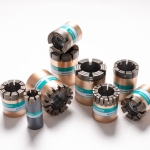
Central to this shift is the hammer bit. Unlike standard diamond surface-set bits, the hammer bit is engineered to thrive under the extreme mechanical stresses of impact-driven drilling.
Understanding the Mechanics of Percussive-Rotary Drilling
The efficiency of a hammer bit lies in its unique methodology. Traditional rotary drilling relies heavily on the shear strength of the rock and the abrasive power of diamond segments. However, in igneous or metamorphic rock, this method often results in excessive heat and slow progress.
The hammer bit, when paired with the corresponding DTH (Down-the-Hole) hammer, enables percussive-rotary drilling. This process breaks the rock through a synchronized three-fold action:
-
Weight on Bit (WOB): The drilling rig applies a constant downward force.
-
Rotation: The drill pipe rotates the bit to ensure the cutting face contacts new rock surfaces.
-
Impact Loads: High-pressure compressed air is injected through dual-wall or standard drill pipes to drive the hammer’s internal piston, delivering high-frequency strikes to the bit.
By breaking the rock under the combined action of drilling pressure, rotation, and impact, the hammer bit significantly enhances efficiency compared to traditional rotation-only methods.[1]
Core Advantages for Modern Exploration Projects
The hammer bit offers several distinct technical advantages that justify its role in a professional drilling program:
1. High Penetration Rates in Hard Rock
The primary benefit of the hammer bit is its ability to fracture rock upon impact. This mechanical advantage allows for a much higher ROP in formations like granite or basalt. For exploration teams, this means faster project completion and reduced labor costs.
2. Production of Straighter Boreholes
Borehole deviation is a common headache in deep-hole exploration. Because the impact energy of a hammer bit is delivered axially (directly down the center of the hole), the bit is less likely to wander or deflect when hitting sloping rock layers. Straighter holes ensure that geological data and core samples are geographically accurate.
3. Continuous Sampling Without Lifting the Drill String
In many exploration setups, especially when using Reverse Circulation (RC) systems, the hammer bit allows for continuous sampling. Cuttings are carried by air up the center of the dual-wall pipe. This eliminates the need for frequent "tripping" of the drill string to retrieve samples, drastically increasing uptime.
4. Controlled Environmental Impact
Modern hammer bits are designed to work with advanced air systems that allow for controllable dust pollution. By managing the airflow and cuttings discharge, operators can maintain a safer and more compliant worksite, which is increasingly important under modern ESG (Environmental, Social, and Governance) standards.
Conclusion
Hard rock drilling is a cost game. Every slow meter, every crooked hole, every dusty shift eats into your margin. The hammer bit solves these problems at the mechanical level: it breaks rock faster, keeps holes straighter, and runs cleaner. That is why more exploration contractors and water well drillers are switching to rotary percussion methods.
At ROCKCODE, we understand the practical demands faced by geological drilling companies in real field conditions. Our focus is not limited to manufacturing drilling tools. We pay attention to how hammer bits actually perform in abrasive formations, deep-hole drilling environments, and long-duration exploration operations. By combining stable raw material selection, precision manufacturing, and strict quality control, ROCKCODE provides hammer bit solutions designed for demanding geological exploration applications.
→ For more information about ROCKCODE’s Products, please visit: https://www.rockcodebit.com/geotechnical-core-bits
→ Email us at: info@rockcodebit.com
→ Information in this article is for general reference only. For specific drilling projects and drilling bits, please consult qualified professionals. Thank you.
Source:
1.https://pmc.ncbi.nlm.nih.gov/articles/PMC13084513/
https://www.rockcodebit.com/what-makes-a-high-performance-hammer-bit-in-hard-rock-drilling.html